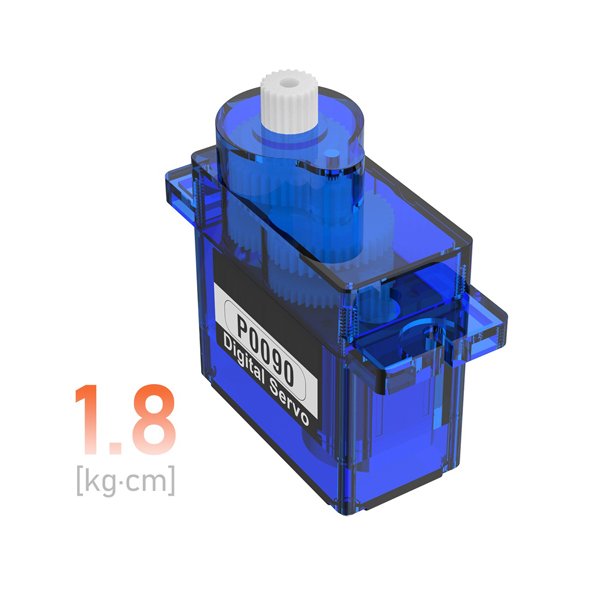
Spec a micro servo in this order: torque (calculated load × 1.5 safety factor, never trust datasheet numbers at face value), voltage rail (4.8V / 6V / 7.4V HV — must match your BEC, not “close enough”), gear material (metal for any duty cycle above intermittent), and physical envelope (verify mounting tabs and spline count against your CAD, not the marketing label). Skip analog if holding torque matters. Skip plastic gears if anything impacts the horn. The rest is noise.
I’ve been specifying, abusing, and autopsying micro servos for over a decade — across RC airframes, animatronic rigs, and small autonomous platforms. If you’re sourcing these for production or a serious build, this guide is the cheat sheet I wish I had on day one.
A few hard truths before we start:
The 2026 micro servo market is louder than it’s ever been. HV coreless units are pushing 5+ kg-cm out of a 12g package. Brushless micros have finally crashed below the $25 threshold. And the SG90 — still the most-sold servo on Earth — is now counterfeited at a roughly 4:1 ratio on open marketplaces.
Pick wrong and you’re not just over budget. You’re shipping a product that browns out, strips gears, or burns its control board the first time a customer pushes it past 70% load. Let’s avoid that.
What Actually Counts as a “Micro Servo”
A micro servo is a closed-loop rotary actuator weighing roughly 9 to 15 grams, driven by a PWM signal, packaged in what the industry calls the “9g form factor” — about 22 × 12 × 22 mm. The internals are mechanically identical to a standard servo: brushed DC motor, reduction gear train, potentiometer for position feedback, control PCB. Just shrunk.
Where it sits in the hierarchy:
| Class | Weight | Footprint (L × W × H) | Where It Belongs |
|---|---|---|---|
| Nano / sub-micro | 1–5 g | 20 × 8 × 20 mm | Indoor airframes, micro drones |
| Micro (9g) | 9–15 g | 22 × 12 × 22 mm | Park flyers, 1/18 RC, small robotics |
| Mini | 16–30 g | 30 × 12 × 30 mm | 450-class helis, 1/14 RC |
| Standard | 40–60 g | 40 × 20 × 36 mm | 1/10 RC, scale models, payload robotics |
One warning up front: “9g” is a marketing handle, not a standard. I’ve measured “9g” servos at 11g, with mounting tabs offset by 0.4mm from the supposed reference. If you’re designing 3D-printed mounts or injection-molded enclosures around these, CAD off the actual unit you intend to source — not a generic STEP file.
[IMAGE: Standard 40g servo, MG90S, and 3.7g nano servo on a cutting mat. Alt: Size comparison of standard, micro, and nano hobby servos]
The 9 Specs That Actually Move the Decision
Datasheets list 20+ parameters. Nine of them matter for procurement.
1. Torque (kg-cm or oz-in)
Rotational force at the output shaft. A 2 kg-cm servo holds 2 kg at 1 cm from the spline — or 1 kg at 2 cm. Halve the leverage, double the capacity, and vice versa. Standard 9g micros land between 1.5 and 2.5 kg-cm. Premium 2026 brushless models hit 5+ kg-cm in the same envelope.
Note: every torque spec assumes a fresh servo on a clean voltage rail. Real-world output drops 10–20% over the first 50 hours of duty.
2. Speed (sec/60°)
Time to sweep 60° unloaded. Average is 0.10–0.12s. Sub-0.06s exists but draws hard on the BEC and overshoots if your control loop isn’t damped. Faster isn’t automatically better.
3. Operating Voltage
Three rails dominate: 4.8V (legacy NiMH), 6.0V (modern BEC default), and 7.4V HV (direct 2S LiPo). Mix them up and you’ll cook a board. I’ve watched a colleague drop a non-HV servo onto a 7.4V rail “just to test” — control PCB was dead in under ten seconds. No smoke, no warning, just a brick.
4. Stall Current
The spec most beginners ignore and most failures trace back to. Idle draw on a digital micro is 5–15mA. Stall current — when the output is mechanically jammed but the motor keeps trying — spikes past 800mA on common units, well over 1.2A on high-torque digitals. If your BEC is sized for nominal load, a single stall event will brown out the whole rail and reset your controller.
5. Gear Material
| Material | Trade-off | Where It Wins |
|---|---|---|
| Nylon / plastic | Light, quiet, cheap; strips on impact | Indoor flight, animatronics |
| Karbonite (composite) | Wear-resistant; brittle under shock | Sailplane control surfaces |
| Metal (brass / steel) | Survives crashes; +2–3g, slight gear noise | RC cars, robotics, anything outdoor |
| Titanium | Premium lifecycle; $50+ price | Competition only |
Plastic gears in a crash-prone application is a false economy. The replacement labor alone outweighs the BOM savings.
6. Bearings vs. Bushings
Cheap units run a single brass or plastic bushing on the output shaft. They develop lateral slop within a few hundred hours. Premium units use dual ball bearings — a non-negotiable for anything with continuous duty. Always confirm in the datasheet, not the listing.
7. Pulse Width Range
Standard is 1000–2000µs with 1500µs as neutral. Some robotics-grade units accept 500–2500µs for full 180° or 270° travel. Mismatch this against your library and you lose 30% of mechanical range without realizing it.
8. Deadband Width
The smallest pulse change (in µs) the servo will respond to. 5µs is fine for a foam plane. 1µs is mandatory for camera gimbals and flybarless heli heads. Smaller deadband = smoother control, but more hunting if the supply isn’t clean.
9. Spline Count and Case Dimensions
Most micro servos use a 20T or 21T spline. There is no universal standard. KST, Futaba, TowerPro, and Hitec all differ. Wrong horn = stripped spline within a few cycles. Verify before you commit.
Analog vs. Digital, Brushed vs. Coreless vs. Brushless
Two orthogonal decisions. The marketing collapses them; engineers shouldn’t.
Circuit type (Analog vs. Digital)
Analog drives the motor at ~50 Hz update rate. Cheap, low idle draw, soft holding. Digital uses a microcontroller pulsing at 300+ Hz. Higher holding torque, sharper response, more current, audible “singing” at rest.
Pick analog only if you’re cost-constrained or building something where servo noise is unacceptable (animatronics on a film set). Everywhere else, digital wins.
Motor type
| Motor | Response | Lifespan | Price | Fits |
|---|---|---|---|---|
| Brushed | Average | 100–200 hours | $2–8 | Budget, education, prototyping |
| Coreless | Very fast | 150–300 hours | $10–25 | 3D aerobatics, fast control surfaces |
| Brushless | Fast and smooth | 1,000+ hours | $20–60 | Robotics, competition, anything continuous duty |
The 2026 inflection point: brushless micros have crossed the cost barrier. If your BOM allows it and the duty cycle is more than a few minutes per hour, brushless pays for itself in lifecycle.
[IMAGE: Cutaway comparison of brushed, coreless, and brushless micro servo internals. Alt: Anatomy of brushed vs coreless vs brushless servos]
Torque Calculation: Don’t Guess
Undersized torque on a flying control surface is how you discover “blowback” — wind pressure backdrives the horn against the gear train, and you watch your aircraft auger in. Same principle on robot joints under static load: the servo can’t hold position, so it heats, then it dies.
The formula is trivial:
Torque (kg-cm) = Load (kg) × Lever arm (cm) × Safety factor (1.5–2.0)
Example 1: Robotic arm joint
Lifting a 200g object at 10 cm reach.
0.2 × 10 × 1.5 = 3.0 kg-cm minimum.
An SG90 (1.8 kg-cm) burns out in days. An MG90S is borderline. Spec a 3.5+ kg-cm digital metal-gear like the Savox SH-0255MG.
Example 2: RC airplane aileron (hobbyist approximation)
Torque (oz-in) = 8.5 × 10⁻⁶ × (MPH)² × (sq-in) × (degrees throw)
40-inch foamie at 40 MPH, 10 sq-in aileron, 20° throw:
8.5 × 10⁻⁶ × 1600 × 10 × 20 = 2.72 oz-in (~0.19 kg-cm).
Any standard 9g micro has 7× margin. Move on.
Example 3: Animatronic jaw
40g mass, 6cm pivot-to-CG, SF 1.5:
0.04 × 6 × 1.5 = 0.36 kg-cm.
A 3.7g nano clears it.
I once spec’d “exactly” the calculated torque on a 600g foam airframe. Stripped its gears mid-loop, recovered the airframe in two pieces. Never spec at 1.0×. 1.5× is the floor. 2.0× for anything that crashes or operates near continuous duty.
Application-to-Servo Decision Matrix
| Application | Spec | Why |
|---|---|---|
| Sub-250g RC plane | Plastic gear, analog, 4.8V | Weight is the constraint |
| 3D aerobatic plane | Coreless digital, <0.09s | Snap centering matters |
| 1/18–1/24 RC crawler | Metal gear, digital | Steering eats rocks; plastic strips day one |
| Robotic arm / hexapod | Brushless, metal gear | Continuous holding load kills brushed motors |
| Camera gimbal | Digital, ≤1µs deadband | Anything more shows as jitter on video |
| Animatronics | Analog, metal gear | Quietest option; no digital singing |
| DLG / F5J sailplane | HV coreless digital | Fast centering, low idle draw |
Top Micro Servos Worth Specifying in 2026
Counterfeit warning: SG90s under $2 are fake. Counterfeits routinely bench at half rated torque and strip within a few hundred cycles. For procurement, buy from authorized distributors only. The savings on gray-market units evaporate the moment you hit a return rate above 3%.
| Model | Gears | Motor / Circuit | Torque @ 4.8V | Speed | Price | Best Fit |
|---|---|---|---|---|---|---|
| EMAX ES08MA II | Metal | Brushed / Analog | 1.6 kg-cm | 0.12s | ~$6 | Best all-rounder |
| TowerPro SG90 (genuine) | Plastic | Brushed / Analog | 1.8 kg-cm | 0.12s | ~$4 | Foam planes, education |
| TowerPro MG90S | Metal | Brushed / Analog | 1.8 kg-cm | 0.10s | ~$7 | Workhorse default |
| PowerHD TR-4 | Metal | Brushed / Digital | 1.8 kg-cm | 0.15s | ~$15 | Micro RC crawlers |
| Savox SH-0255MG | Metal | Coreless / Digital | 3.1 kg-cm | 0.16s | ~$30 | 450 helis, robotics |
| KST X08 V6 | Metal | Coreless / Digital | 2.2 kg-cm | 0.09s | ~$45 | DLG / F5J competition |
Verify pricing at order time — 2026 supply has been volatile.
Failure Modes (Why Servos Die on Your Bench)
After autopsying maybe 60+ dead micros over the years, the same five causes show up again and again.
Endpoint binding. You command 90°, a linkage stops the horn at 70°. The motor pulls stall current indefinitely. Coils overheat, control PCB cooks. Always set EPA in the transmitter or clamp commanded angles in firmware.
Gear strip from impact. Plastic teeth shatter under back-drive shock. Use servo savers on RC cars. Spec metal anywhere outdoor.
Jitter / twitch. Worn pot, or — far more often — undersized BEC. A 1A BEC feeding three digital servos sees voltage drops on every centering pulse. Upgrade to 3A+ and add a glitch capacitor on the receiver rail.
Browning out the host. Powering a stalled 9g micro from an Arduino’s 5V pin will reset the MCU instantly. The onboard regulator can’t source 700mA. Use a dedicated BEC, share grounds.
Spec’d at 1.0× safety factor. Calculated load is the bare minimum the servo must produce. Dynamic loads, friction, gear backlash, and component aging eat the rest. 1.5× minimum, every time.
When Not to Use a Micro Servo
A trust-signal section, because nobody else writes one. Size up if:
- 1/10-scale RC steering — shock loads will obliterate a micro. Spec a 40g+ standard.
- Humanoid or heavy robotic legs — anything over 1 kg lacks thermal headroom in a micro. Servos overheat during continuous walking.
- Continuous-rotation drive — servos position; they don’t run. Use a DC gear motor.
- Camera stabilization — even 1µs deadband loses to a brushless gimbal motor.
- Submerged / dusty environments — micros are not sealed. IP-rated industrial units exist for a reason.
- 24/7 duty cycles — these are intermittent-use parts. Industrial actuators are the right tool.
Procurement Checklist
Before the PO goes out:
- Calculated torque with ≥1.5× safety factor
- Voltage rail confirmed against the actual BEC, not the spec sheet
- Metal gears unless the application is genuinely load-free
- Dual ball bearings verified in the datasheet
- Spline count matched to horn inventory
- Stall current within BEC headroom
- Mechanical envelope verified to ±0.5mm against CAD
- Sourcing through authorized distribution
- One spare per ten units for QA / replacement
- Servo tester on the receiving bench before installation
- Centered at 1500µs before horn install
- Threadlocker on horn screws (vibration backs them out fast)
FAQ
MG90S vs. SG90 — what’s the actual difference?
Same case, same form factor. The SG90 runs nylon gears at ~9g; the MG90S runs metal gears at ~13g with marginally higher torque (2.2 vs. 1.8 kg-cm). The SG90 strips on impact. The MG90S survives most crashes. For anything outdoor or load-bearing, default to MG90S.
Can I run a micro servo on a 3.7V 1S LiPo?
Not a standard one. They’ll move sluggishly and lose 30%+ rated torque below 4.8V. Several Emax and KST models are explicitly 1S-rated — spec those.
Why does my digital servo buzz at rest?
Digital servos pulse at 300+ Hz to hold center against linkage load. The “singing” is normal micro-correction. If it turns into grinding, the gears are stripped.
How do I bench-test a suspect servo?
$5 servo tester. Smooth sweep through the range = electronics intact. Skipping or grinding = stripped gears. Servo hot to the touch within seconds = motor shorted, scrap it.
What causes random twitching in flight?
Three suspects, in order: undersized BEC under transient load, noisy PWM line (add a 100nF cap across servo power), or mechanical binding at end-stops. Check power first.
Smallest metal-gear micro available?
PowerHD DSM44 (~4.4g, 1.3 kg-cm) and Emax ES9251 II (~3.5g, 1.0 kg-cm) are the lightest production metal-gear micros with usable torque.
Servos with Raspberry Pi GPIO?
Software PWM works but jitters visibly. Use a PCA9685 16-channel driver — $5, solves it cleanly.
About the Author
Robin Luo: Senior robotics hardware engineer with 10+ years across custom flight controllers, animatronic rigs, and autonomous rovers. Hundreds of flight hours logged, 50+ servo models bench-tested, and more dead SG90s on the shelf than I’d like to admit.